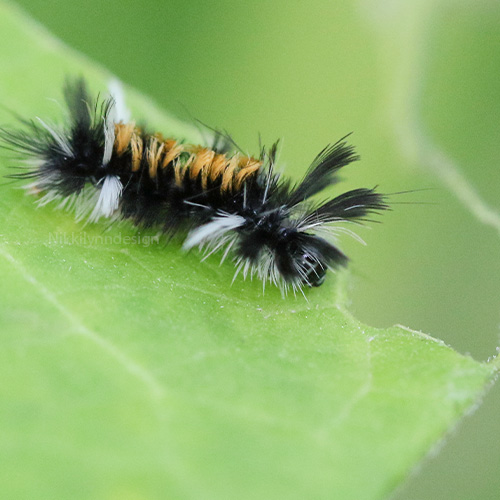
Milkweed Tussock Moth Caterpillar (Euchaetes egle)
If you’ve ever raised monarch caterpillars or checked your backyard milkweed plants in Wisconsin in late summer, you may have found a fuzzy black-white-orange caterpillar that isn’t a monarch. That’s the milkweed tussock moth caterpillar (also called the milkweed tiger moth). It’s a native species that feeds on milkweed (and sometimes dogbane) and often shows up in clusters, especially in the earlier instars.
In the Upper Midwest, these caterpillars typically appear from mid- to late summer into early fall. In this post you’ll learn how to identify milkweed tussock moth caterpillars, what their life cycle looks like, and how to handle them safely (yes—those hairs can irritate skin).
Quick Identification
- Early instars: pale gray with light hairs; usually feed in groups and “skeletonize” leaves.
- Late instars: bold tufts of black, white, and orange/yellow bristles; may wander and appear alone.
- Host plants: most often milkweed (Asclepias); sometimes dogbane (Apocynum).
- Common timing (Midwest): mid- to late summer into early fall, depending on your year.
Monarch vs tussock moth: Monarch caterpillars have smooth, banded stripes and “horns” (tentacles). Milkweed tussock moth caterpillars look fuzzy with bristly tufts and often feed in groups early on. If you’re raising monarchs, here’s my full life cycle of a monarch butterfly guide.
For close-up ID: A small 10x hand lens helps you spot egg clusters, tiny early instars, and leaf “skeletonizing” damage.
Milkweed is a Habitat Plant
Milkweed supports far more than monarchs. A healthy patch can host milkweed tussock moth caterpillars, milkweed bugs, aphids, and other native insects sharing the same plant.
Milkweed flowers also attract native pollinators, such as mason bees. If you’re building a stronger patch at home, I have a step-by-step post on collecting and planting milkweed seed.
What Else Lives on Milkweed?
- Monarch butterfly life cycle
- Milkweed bug guide
- Milkweed plants in Wisconsin (types & where they grow)
Basic Information
| Scientific name | Euchaetes egle |
| Common names | Milkweed tussock moth / Milkweed tiger moth |
| Host plants | Milkweeds (Asclepias spp.); sometimes dogbane (Apocynum spp.) |
| Range | Southern Canada through much of the U.S., including the Midwest; south into Texas and Florida |
| Size | Up to ~35 mm as a mature caterpillar |
| Overwintering | Overwinters as a pupa inside a gray, hair-felted cocoon |
| Generations | Often 1/year in northern areas; more in the south |
| Defense | Sequesters defensive chemicals from host plants (milkweed/dogbane) |
| Skin irritation | Hairs can cause an itchy rash for some people—avoid bare-skin handling |
Seeing milkweed tussock moth caterpillars doesn’t mean your milkweed is “bad.” It usually means your patch is doing its job as habitat—supporting multiple native species across the season.
Life Cycle (4 Stages)
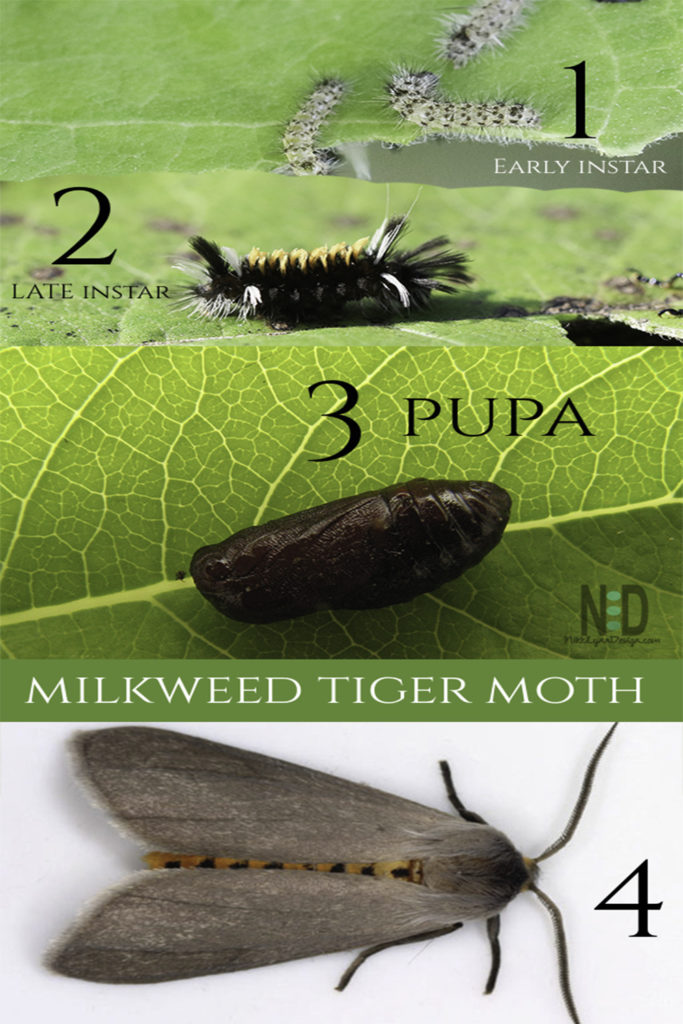
The milkweed tussock moth goes through four stages: egg → larva (caterpillar) → pupa → adult moth. The caterpillar stage is where you’ll notice the most activity on milkweed plants.
Stage 1: Early Instars (Young Caterpillars)
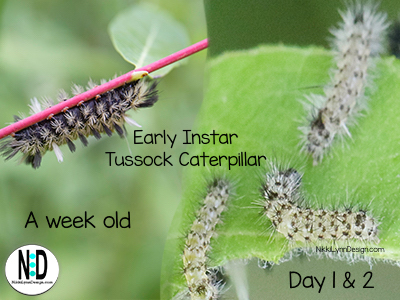
Early instars hatch from egg masses and usually begin feeding in large groups. Instead of chewing whole leaves immediately, they often skeletonize the leaf surface, leaving behind a lacy pattern.
- Often seen in clusters on the same plant.
- Light gray bodies with fine hairs at first.
- Can strip a plant quickly if the group is large.
Stage 2: Late Instars (Older Caterpillars)
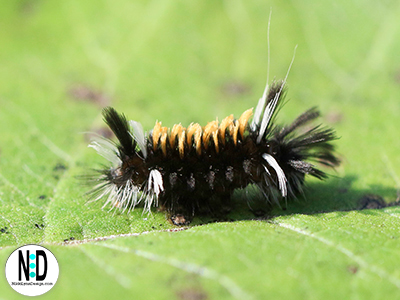
- Size: up to ~35 mm
- Look: black/white/orange (sometimes yellowish) bristles
- Behavior: less “packed together” than early instars; may wander
- Food: milkweed leaves; sometimes dogbane
This is the stage most people photograph—bold, fuzzy, and unmistakable once you’ve seen one. The orange tufts along the back can look yellowish in certain light.
Stage 3: Pupa (Cocoon)
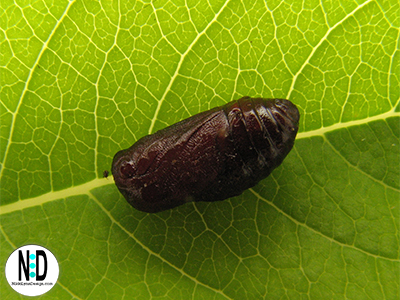
When it’s ready to pupate, the caterpillar leaves the milkweed and spins a gray cocoon felted with its own hairs. In colder climates (including the Midwest), it typically overwinters as a pupa and emerges as a moth the following season.
Stage 4: Adult Moth
- Eggs: laid in clusters (often on the underside of leaves)
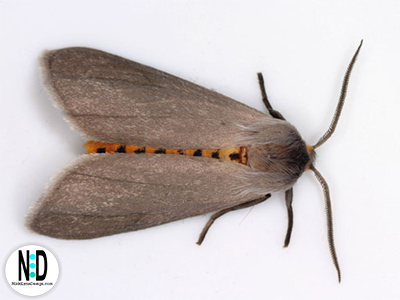
- Adult ID: gray wings; yellow abdomen with rows of black dots
After mating, females lay egg masses on host plants. The eggs hatch, and the cycle repeats.
What to Do If You’re Raising Monarchs
(and Find Tussock Moths)
If you’re collecting milkweed for monarch caterpillars, it’s smart to check leaves closely. Milkweed tussock moth caterpillars can eat a lot of leaf material quickly, especially in groups.
- Inspect before bringing milkweed indoors: check undersides of leaves for egg masses and small, clustered larvae.
- Use separate milkweed sources: if one patch has tussock moth larvae, harvest monarch leaves from a different patch when possible.
- Avoid “cleaning” the yard with pesticides: milkweed supports many native insects (and pesticides can harm monarchs, too).
For close-up ID: A small 10x hand lens helps you spot egg clusters, tiny early instars, and leaf “skeletonizing” damage. Fine-tip tweezers make it easier to keep leaves clean and handle tiny larvae without touching them.
Can They Cause a Rash?
Sometimes, yes. The bristly hairs can irritate skin—especially if you handle the caterpillar directly and then rub your face or eyes. If you’re sensitive, treat them like you would stinging nettle: look, photograph, and let them be without bare-hand contact.
- Use gloves or a leaf/twig to move them if you must.
- Wash your hands after handling milkweed leaves from an active patch.
- If you develop itchiness, gently wash the area and avoid scratching.
Optional gear: If you’re sensitive to irritating hairs, a simple pair of nitrile gloves makes it easy to inspect milkweed leaves without direct skin contact.
Birds & Late-Summer Feeding
Milkweed patches don’t just support butterflies—they support birds, too. In late summer, many species depend on insects and caterpillars to fuel migration or feed young birds.
The Downy Woodpecker is a great example of an insect hunter, and if you want, you can learn about the 9 Woodpeckers of Wisconsin for a broader guide of additional woodpeckers.
Two more backyard favorites that hunt insects are the White-breasted Nuthatch and Red-breasted Nuthatch.
FAQ
Are milkweed tussock moth caterpillars “bad” for milkweed?
No. They’re a native milkweed feeder. A large group can defoliate a plant, but established milkweed patches usually recover. Their presence is a sign that your milkweed is functioning as a habitat.
What time of year do you see them?
Most sightings are mid- to late summer into early fall (timing varies by region and weather). In northern areas, they often have one main generation per year, and the pupa overwinters.
What do they turn into?
They turn into a gray adult moth with a yellow abdomen marked by black dots (milkweed tussock moth/milkweed tiger moth).
More Life Around Milkweed
If you’re building a backyard habitat, these related posts pair naturally with what you’re seeing on milkweed throughout the season:
- Milkweed plants in Wisconsin (types & where they grow)
- Collecting and planting milkweed seed
- Life cycle of a monarch butterfly
- Milkweed bug: what it is & why it’s on your plants
Sharing is Caring (Pin me)
AFFILIATE POLICY: Posts on this site may contain links to outside vendors that pay me a commission when you purchase from them, at no additional cost to you. Thank you for supporting this site!