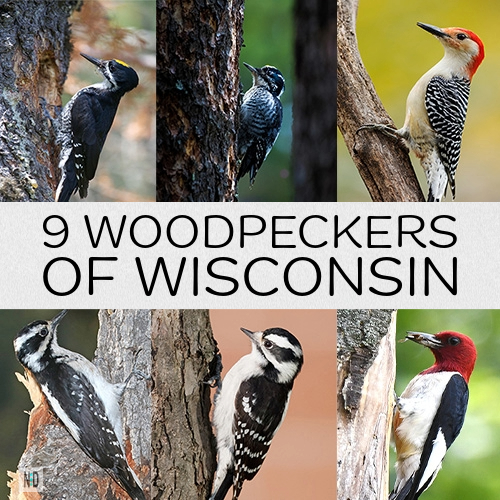
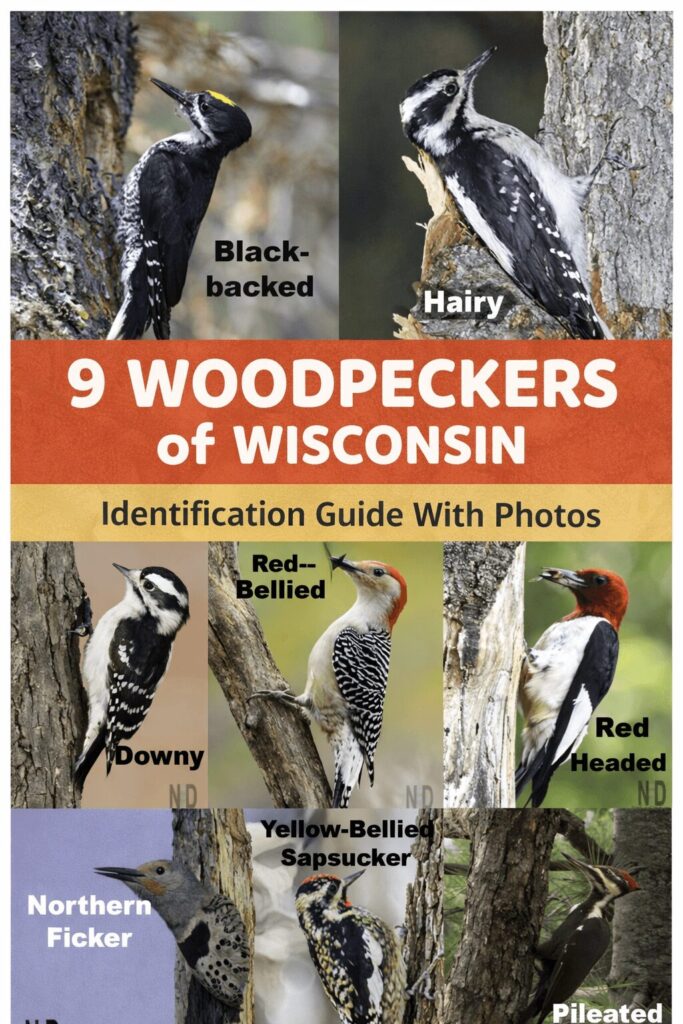
There are 9 types of woodpeckers regularly found in Wisconsin. From the large Pileated Woodpecker to the small Downy Woodpecker, this guide will help you identify each species by size, markings, habitat, and seasonal behavior.
In This Guide
- Northern Flicker
- Yellow-bellied Sapsucker
- Pileated Woodpecker
- Red-headed Woodpecker
- Red-bellied Woodpecker
- Downy Woodpecker
- Hairy Woodpecker
- American Three-toed Woodpecker
- Black-backed Woodpecker
9 Woodpeckers of Wisconsin
1.) Northern Flicker
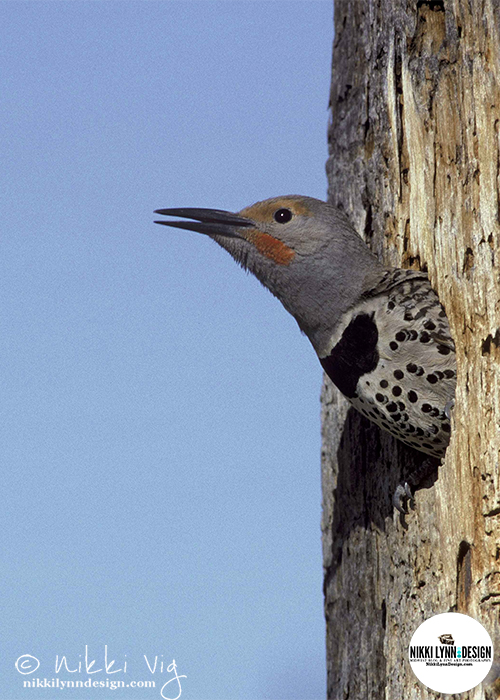
Flicker’s appearance differs by region that they are from (Eastern vs Western). Western flickers have some yellow in their tail feathers.
Characteristics of the Northern Flicker
- 12 inches tall with a brown barred back and spotted tan to cream bellies.
- The birds have red napes, and males sport a mustache behind their bill.
- They have curved beaks and a tongue that is three inches longer than their bills to reach into the logs and trees that they are drilling on.
All flicker birds are fun to watch, searching for insects in trees and lawns.
Additional Reading: All About the Northern Flicker
2.) Yellow- Bellied Sapsucker
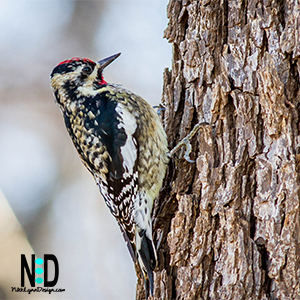
The yellow-bellied sapsucker is a medium-sized woodpecker that breeds in Canada. These woodpeckers feed on sap, which they obtain by drilling holes in the trunks of trees.
Characteristics of the Yellow-Bellied Sapsucker
- 9 to 21 centimeters (7.5 to 8.3 in.
- The forehead is bright red in males and paler in females.
- Usually inhabits forests, forest edges, & open woodlands.
The species gets its common name from the yellowish wash of color across its chest, belly, and back. The males have a very distinct red patch on the throat, while the same area in the females is white.
Additional Information on Birds: Birds of Wisconsin
3.) Pileated Woodpecker
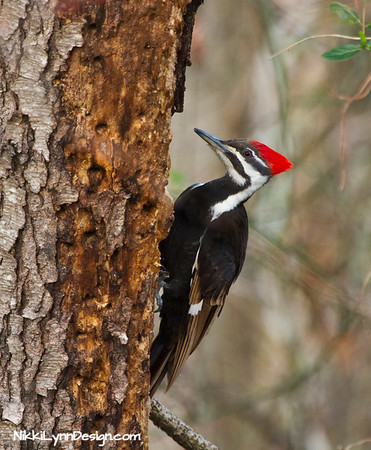
The pileated woodpecker is the largest woodpecker in North America. The term pileated comes from the Latin word pileatus, meaning “capped” which refers to the red crest on the top of the birds head.
Characteristics of the Pileated Woodpecker
- Adults are 16 – 19 inches long.
- They have a wingspan of 26-30 inches.
- Mainly a black bird with a red crest and a white line running down the throat.
- Large bill
- Whack-a-wack-a-wack call
Pileated woodpeckers often chip out large and roughly rectangular holes in trees while searching out ant colonies.
Additional Post: All About the Pileated Woodpecker
4.) Red-Headed Woodpecker
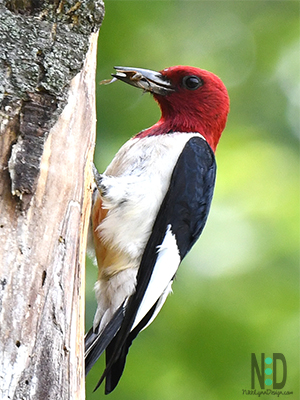
Red-headed Woodpecker {Melan- erpes erythrocephalus). Central portions of the United States and southern Canada; rare east of the Hudson River and west of the Rocky Mts.
Characteristics of the Red – Headed Woodpecker
- About 9 inches in length.
- Back, wings, and tail glossy blue-black.
- Upper tail coverts and under parts below the breast are white.
- Whole head, neck, chin, throat, and upper breast crimson.
- Outer tail feathers are often tipped with white.
- Migrate back during April or May.
The red coloring of young red headed woodpeckers is replaced with gray, streaked with blackish. Under parts dusky white or grayish. Feathers of the back are edged with gray.
5.) Red-bellied Woodpecker
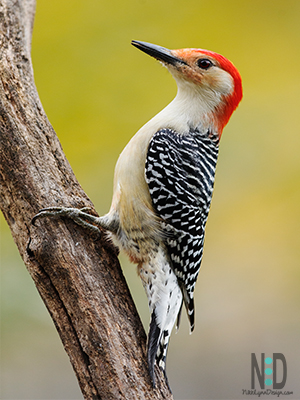
The Red-bellied. Woodpecker is found in the United States East of the Rockies and South of New England.
Characteristics of the Red – Bellied Woodpecker
- Adults are 9.5 inches in length.
- The whole crown and nape are red on males.
- The female-only has a red nape, the crown is grayish brown.
- The back and tail are black barred with white.
- Rump white and underparts grayish white.
The red-bellied woodpecker expresses foraging behavior by catching or storing food in trees.
Additional Reading: All About The Red-Bellied Woodpecker
6.) Downy Woodpecker
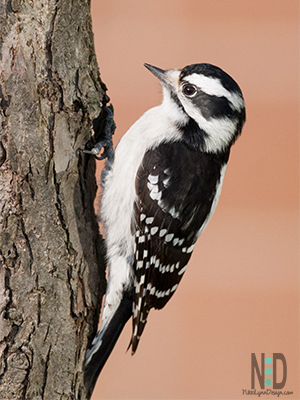
Downy woodpeckers are the smallest of North America’s woodpeckers, but there are many smaller species elsewhere, especially the piculets.
Characteristics of the Downy Woodpecker
- Mainly black on the upper parts & wings, with a white back, throat & belly.
- White bar above the eye and one below.
- 14 to 18 cm (5.5 to 7.1 in)
- Wingspan from 25 to 31 cm (9.8 to 12.2 in).
- Found in North America in woodland areas, gardens, parks & orchards
The Downy Woodpecker is often confused with the larger Hairy Woodpecker. See the detailed guide on Downy vs Hairy Woodpecker differences for a side-by-side comparison.
Additional Reading: All About The Downy Woodpecker
7.) Hairy Woodpecker
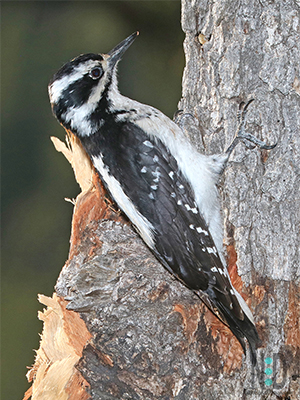
The hairy woodpecker is a medium-sized woodpecker that inhabits mature deciduous forests and is one of the 9 woodpeckers in Wisconsin.
Characteristics of the Hairy Woodpecker
- Approximately 250 mm (9.8 in) in length.
- White bar above and one below the eye.
- Adult males have a red patch on the back of the head.
It is virtually identical in plumage to the smaller downy woodpecker. The downy has a shorter bill and can be seen in #6 above.
Additional Reading: Side by Side Comparison Between Hairy & Downy
8.) American Three-toed Woodpecker
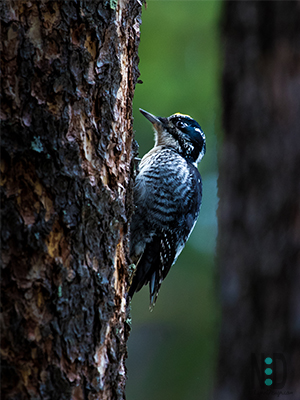
The American Three-toed woodpecker is a medium-sized woodpecker which is native to North America. They have a black head with one black stripe by their beak, the wings and rump are also black.
Characteristics of the American Three-toed Woodpecker
- About length of 21 cm (8.3 in)
- Adult male has a yellow cap on the head.
- White from the throat to the belly; the flanks are white with black bars.
- Found occasionally around waters that border Lake Superior in upper Wisconsin.
They forage on conifers in search of wood-boring beetle larvae, Spruce Beetle, or other insects. They also eat fruit and tree sap.
9.) Black-backed Woodpecker
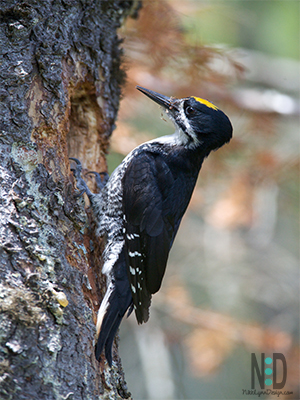
The black-backed woodpecker is a medium-sized woodpecker with three toes on its feet that is found in North America.
Characteristics of the Black-backed Woodpecker
- About 23 cm or 9.1 inches in length.
- Mainly a black bird with a white stomach.
- Adult males have a yellow cap.
- Found in the northern half of Wisconsin.
The woodpecker is also known as the Arctic three-toed woodpecker and closely resembles the American three-toed woodpecker.
AFFILIATE POLICY: Posts on this site may contain links to outside vendors that pay me a commission when you purchase from them, at no additional cost to you. Thank you for supporting this site!